

How Bed Rails Can Support Safer Movement at Night
Night-time movement—getting in and out of bed, turning, or reaching for the bathroom—carries higher risk than daytime activity. Reduced visibility, grogginess, medicines that cause dizziness, and overnight stiffness all raise the chance of missteps and falls.
Bed rails are a practical tool to reduce that risk when used correctly. This article explains how rails support safer movement at night, how to choose and use them, and what other products and practices work well alongside rails to support independence and safety.
Why night-time movement is uniquely risky
At night people often move without fully waking, which impairs balance and decision-making. Environmental hazards—loose rugs, poor lighting, furniture—are harder to see. For people with mobility limitations, cognitive changes, or conditions like neuropathy, these factors magnify risk.
Because of that increased vulnerability, many caregivers combine physical supports—like rails—with monitoring technology such as Bed Exit Alarm Systems to provide both a physical anchor and an early alert if someone attempts to leave the bed unexpectedly.
How bed rails reduce fall risk
Bed rails work in three practical ways:
- Provide a stable handhold during turning, sitting up, and standing.
- Serve as a boundary that reduces rolling out of bed during sleep.
- Act as an assist for repositioning that reduces the need for sudden, unbalanced moves.
For people who wander or attempt unsupervised transfers, combining rails with an alarm can give caregivers time to respond. Products like the Smart Caregiver Bed Exit Alarm with Wireless Pager pair a sensing pad with a pager alert, which complements the stabilizing function of rails.
Choosing the right rail design
Rails come in many heights, lengths, and attachment styles. Key selection criteria include bed type, user height and reach, mattress depth, and whether the rail is for steadying only or to act as a physical barrier.
Common options:
- Low-profile rails for balance and turning assistance without creating a full barrier.
- Full-length rails for those at high risk of rolling out of bed.
- Fold-down rails for caregivers who need regular access to both sides of the bed.
When rails affect how someone transitions to chairs or standing, consider products that support easier transfers and seating options—such as Power Lift Recliner Chairs—which can reduce challenging maneuvers at the bedside.
Safe techniques for using rails during transfers
Using a rail correctly reduces strain and falls. Best practices include:
- Pause and sit at the edge of the bed first, then use the rail to rise slowly.
- Keep feet flat and beneath the body before standing; avoid twisting while holding the rail.
- If weak on one side, lead with the stronger leg and use the rail with both hands if possible.
For repositioning that requires moving a dependent person, use tools designed to reduce friction and caregiver effort, such as Patient Transfer Sheets. These sheets allow safer sideways moves and minimize awkward lifting when getting someone to the bed edge or turning them toward a rail.
When to involve mechanical lifting and assisted devices
If a person cannot safely weight-bear or repeatedly attempts transfers beyond their capability, mechanical solutions may be safer than relying only on rails. Electric Patient Lifts provide powered transfer from bed to chair or commode and reduce caregiver injury risk.
Rails remain useful even when lifts are used—rails help stabilize the user during pre-transfer positioning and act as a support for brief upright tolerance tests before a lift is applied.
Complementary mobility tools for night-time use
After getting out of bed, people often need short-distance mobility to reach bathrooms or bedside chairs. Choosing lightweight, maneuverable mobility aids supports safe night ambulation:
- For short escorted movements or assisted toileting, consider compact options like Transport Wheelchairs.
- Ensure clear paths, bedside lighting, and reachable supports such as a bedside commode or grab bar anchored into the wall or floor.
Foot health, footwear, and night-time safety
Poor foot sensation or foot pain increases fall risk. For people with diabetes or circulation issues, maintaining foot health and wearing appropriate night footwear improves stability and comfort.
Regular skin and wound care products—available in categories such as Diabetic Foot Care Products—help manage issues that can interfere with safe stepping. At night, non-binding, well-fitting options like Diabetic Socks can reduce pressure points and support warmth and circulation, indirectly supporting safer movement.
Practical bedroom setup to maximize rail effectiveness
Even the best rail is less useful in a cluttered, poorly lit room. Follow these practical steps:
- Keep a clear path from bed to bathroom; remove loose rugs and cords.
- Install stable night lights or motion-activated lighting to reduce transitions from dark to bright.
- Place items like phones, glasses, and water within easy reach to avoid unnecessary reaching or standing.
Quick checklist for implementing bed rails safely
- Confirm bed rails are compatible with the bed frame and mattress depth.
- Check that rails are firmly installed and inspected regularly for looseness.
- Teach the user and caregivers correct grip and transfer techniques.
- Combine rails with monitoring if unassisted exits are a concern.
- Keep a clear, well-lit path from bed to bathroom and seating.
- Assess foot health and appropriate night footwear to support stable steps.
FAQ
- Are bed rails appropriate for everyone?
Not always. Rails help many people but may increase risk of entrapment or impede escape for others. Assess individual mobility, cognition, and care needs with a clinician or qualified therapist before installation.
- Will rails make someone more dependent?
When used properly, rails support independence by enabling safer self-transfers. They should be part of a broader plan that includes strength training and mobility aids when needed.
- How do I choose between a rail and a bedside chair or recliner?
For repeated transfers, a Power Lift Recliner Chair or a transfer with mechanical lift may be more appropriate. Rails are best when the user can partially weight-bear and needs balance support.
- Can bed rails be used with alarm systems?
Yes. Combining rails with Bed Exit Alarm Systems or a specific unit like the Smart Caregiver Bed Exit Alarm with Wireless Pager gives both a physical support and timely notification for caregivers.
- How often should rails and related equipment be inspected?
Inspect rails, fasteners, and complementary equipment regularly—weekly if in frequent use—and after any incident or unusual strain. For transfers involving others, tools such as Patient Transfer Sheets should also be checked for wear.
Conclusion
Bed rails can be a reliable part of a safer night-time mobility plan when chosen and used correctly. Pair rails with clear room setup, appropriate footwear and foot care, monitors or alarms when needed, and assisted transfer options for those who cannot safely weight-bear. A practical, individualized approach keeps overnight movement safer and supports independence.
Products Featured in This Article
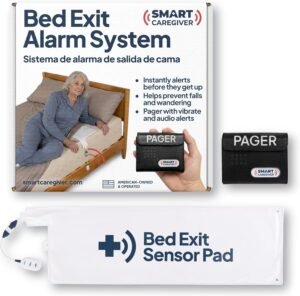
Smart Caregiver Bed Exit Alarm with…
From the brand Reduce Accidents Get early alerts the moment your loved one begins to move…